The world of search is evolving faster than ever. In 2026, traditional SEO is no longer enough. AI-driven engines and answer-focused platforms are changing the way content is discovered, understood, and ranked. If you want your content to reach the right audience, understanding AEO (Answer Engine Optimisation) and GEO (Generative Engine Optimisation) is critical.
Let’s dive into the AI search landscape and explore how to thrive in this new era.
Introduction — The New Search Landscape
Search engines are no longer just about keywords. AI technologies like ChatGPT, Perplexity AI, and Google’s AI tools understand user intent and generate dynamic answers instead of just linking to web pages.
Key changes in 2026:
- Users ask conversational questions instead of typing keywords.
- AI engines can summarise, generate, and even suggest content in real-time.
- Traditional SEO strategies work less efficiently unless integrated with AI-focused techniques like AEO and GEO.
The question now isn’t just “How do I rank?” but “How do I satisfy AI engines while providing value?
What is AEO? (Answer Engine Optimization)
AEO focuses on optimising your content to directly answer user questions. Think of it as making your content AI-friendly for answer boxes and snippet-focused engines.
Key points:
- Direct Answers: Provide concise, accurate answers at the top of your content.
- Structured Data: Use tables, FAQs, bullet points, and schema markup to help AI engines understand your content.
- Contextual Understanding: AI looks for relevance, clarity, and authority, not just keywords.
Example: If someone searches “best laptops under $1000 2026,” an AEO-optimized article provides:
- A clear list of laptops
- Pros and cons
- Price range
- A short recommendation
AI engines love content that directly solves a user’s problem.
What is GEO? (Generative Engine Optimization)
GEO is all about optimizing your content for AI generative models like ChatGPT, Perplexity, and Bing AI. These engines don’t just pull information—they create answers.
Key GEO strategies:
- High-Quality Source Content: Generative AI prefers well-researched, authoritative, and fact-checked content.
- Conversational Structure: Organize your content like a dialogue or step-by-step guide.
- AI-friendly Formatting: Use short paragraphs, clear headings, lists, and examples that AI can pull easily for responses.
Example: If someone asks, “How does solar energy work?” your GEO-optimized article should allow AI to summarize your content into a simple, accurate answer without losing nuance.
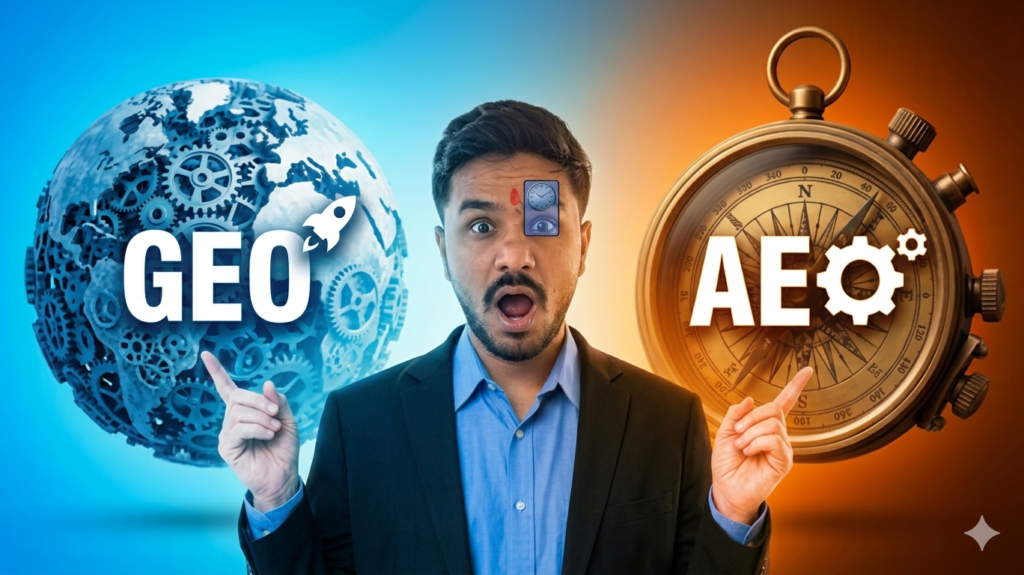
AEO vs. GEO — Side-by-Side Comparison
| Feature | AEO | GEO |
| Purpose | Direct answers to queries | Content usable by generative AI |
| Focus | Structured answers, snippets, FAQs | Conversational, informative, high-quality |
| Content Style | Concise, actionable | Detailed, authoritative, engaging |
| Best For | Google Answer Boxes, search snippets | ChatGPT, Perplexity AI, Bing AI responses |
| Metrics | CTR, snippet appearance, engagement | AI usage, content summarization, citations |
Takeaway: Both AEO and GEO work together. While AEO gets your content noticed by AI engines, GEO ensures your content is usable and shareable by generative AI.
AEO vs. GEO vs. SEO — The Full Triangle
Traditional SEO still matters. In 2026, the full triangle strategy is:
- SEO: Base layer — keyword optimization, backlinks, site speed.
- AEO: Makes your content AI-ready for direct answers.
- GEO: Ensures your content is AI-friendly for generative responses.
Think of it as a pyramid: SEO builds the foundation, AEO targets immediate answers, and GEO ensures your content becomes AI-distributable across platforms.
How to Rank in Google AI Overviews
Google AI now prioritizes answer-oriented content. Here’s how to optimize:
- Use FAQs, tables, lists, and structured headings.
- Start content with a concise summary of the topic.
- Include trusted sources and citations.
- Add semantic keywords naturally instead of stuffing exact-match terms.
- Ensure mobile-first readability and fast page load.
Example: For a search like “AI tools for marketers 2026,” your article should:
- Begin with a clear summary
- List tools with pros/cons
- Include examples and screenshots
Google AI looks for user-centric content, not just SEO-optimized pages.
How to Rank in ChatGPT & Perplexity
Ranking for generative AI is less about keywords and more about answer completeness and clarity. Tips include:
- Detailed content: Provide examples, case studies, and actionable insights.
- Readable format: Short paragraphs, headings, lists, and visual aids.
- Factually correct content: AI pulls information from trustworthy content.
- Context-rich text: AI uses semantic understanding, so context matters more than exact keywords.
Your goal: Make your content the source AI wants to reference when generating an answer.
Measuring AEO & GEO Performance
Tracking AI-focused optimization is new but essential. Consider:
- AEO Metrics: Click-through rate, featured snippet appearance, dwell time.
- GEO Metrics: AI answer usage, summarisation mentions, and backlink authority.
- Combined Metrics: Engagement, conversions, social shares, and repeat visits.
Tools like Google Search Console, AI analytics platforms, and SERP tracking software help measure performance.
Common Mistakes to Avoid
- Keyword stuffing: AI ignores content that isn’t user-friendly.
- Thin content: Short, vague pages won’t rank in AEO or GEO.
- Ignoring schema: Structured data is crucial for AI understanding.
- Poor readability: Long paragraphs and jargon reduce AI usefulness.
- Not updating content: AI prefers current, factual, and fresh content.
Avoid these to maintain high AI search visibility.
Conclusion & Action Checklist
The AI search landscape is changing rapidly. To stay ahead:
- Optimise for SEO basics first
- Implement AEO strategies: direct, structured answers
- Implement GEO strategies: rich, conversational, authoritative content
- Use short paragraphs, headings, lists, and visuals
- Measure performance with AI-focused metrics
- Update content regularly for accuracy and relevance
Final thought: In 2026, success comes to those who create content for humans first, then AI engines. Master AEO and GEO, and your content will thrive across the new AI-driven search landscape.